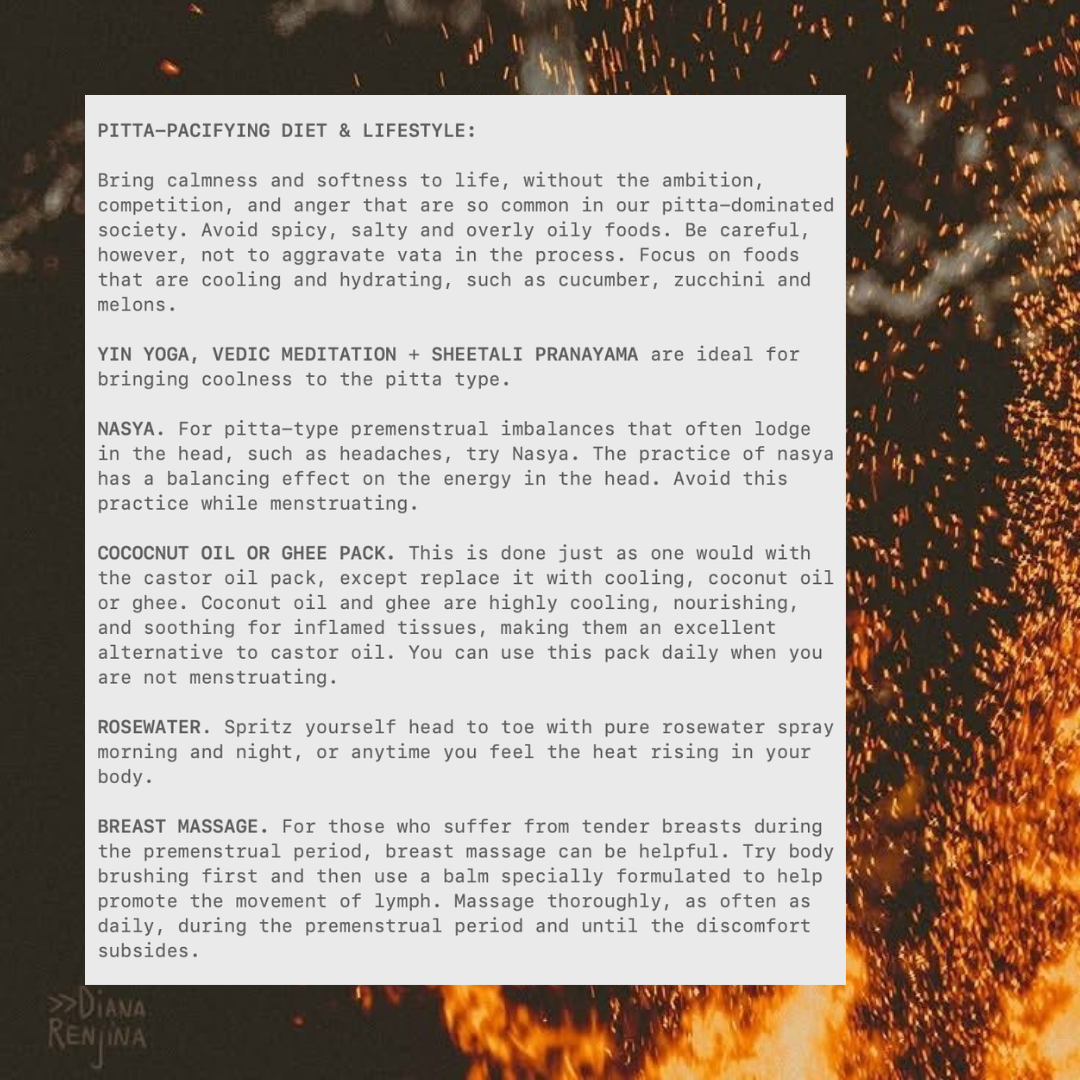
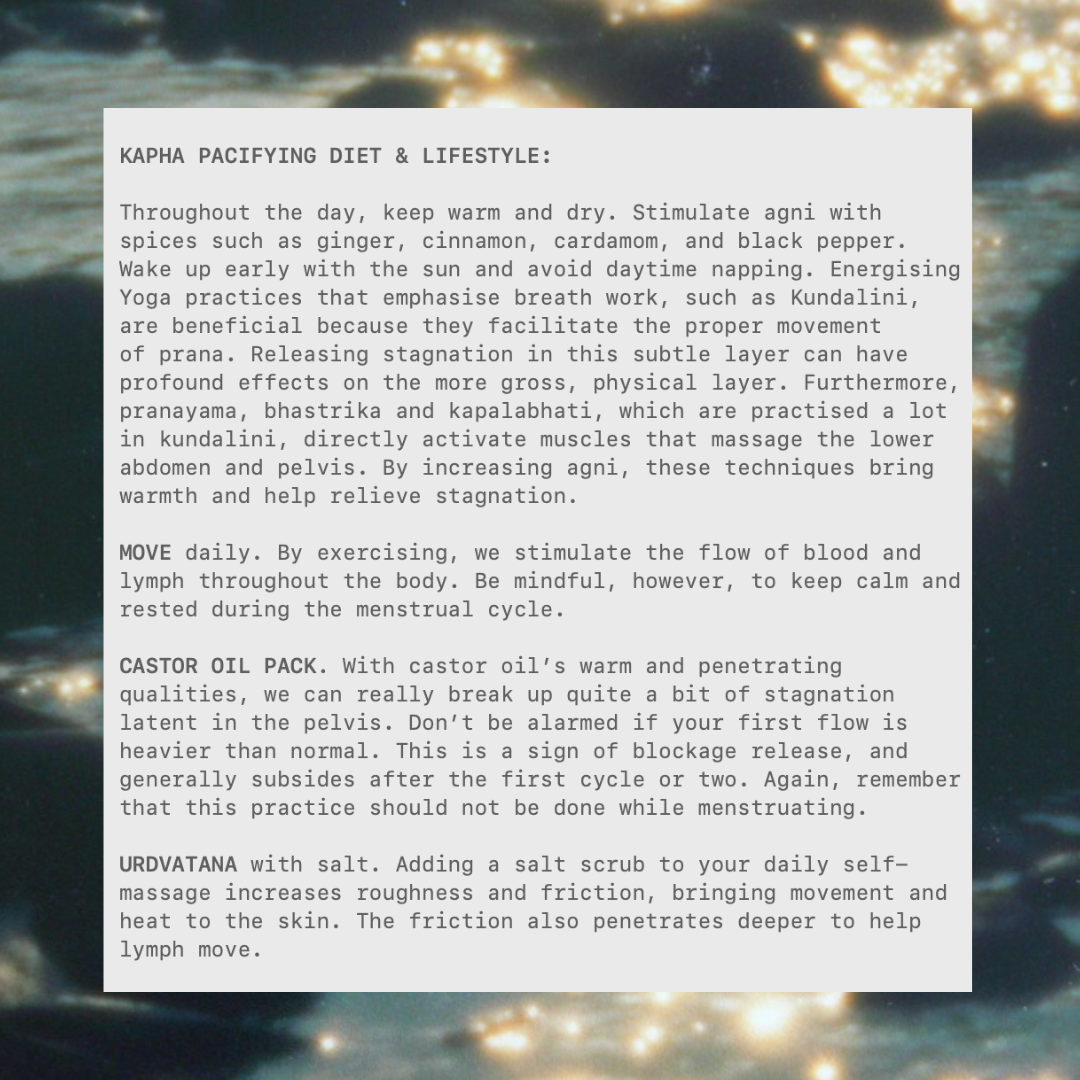
Which Doshic imbalance are you struggling with?
Ayurveda uniquely examines the menstrual cycle as a window into the human body. By being familiar and in tune with your menstrual cycle, you can understand very clearly, on a month-to-month basis, which dosha imbalances your body is struggling with.
The menstrual flow is a byproduct, after all, of the most basic tissues of the body. After we ingest our meal, this food transforms the Sapta Dhatus (seven tissue layers) of the body. The first is plasma, then blood, which is then followed by the muscle and fat tissues. After these four layers come the bony and cartilaginous tissues, nerves, and, lastly, the reproductive tissues.
The actual menstrual flow is considered to be a byproduct of the first layer, rasa dhatu, or the plasma. Plasma is a vehicle for nourishment. It carries hormones, vitamins, minerals, and water—all sources of nourishment. When this layer is healthy and flows freely, so too do all of these nutrients, as well as wastes, so that they may leave the body with ease. The second layer, rakta dhatu, or the layer of blood, is also part of the menstrual flow, releasing excess pitta. The rasa dhatu and rakta dhatu are also the first two to be vitiated by excess vata, pitta, or kapha after they leave their home in the gastrointestinal tract. As such, they are most quick to change in quality and consistency.
By paying attention to your flow, its qualities, and your experiences before and after its release, you can get a strong sense of how the doshas are at play even before they fully come to fruition on a gross level in other layers of the body. This gives an opportunity for intervention so that the physiology of the body may come back to a stronger balance, and therefore, stronger health.